Catacombs of St. Callixtus: Guided Tour
Entry ticket + official guide — the standard way to visit
Guide in: EN, IT, ES, FR, DE
from €15per personCheck Availability
Five catacombs are open to visitors, and most people have time for one, maybe two. This guide settles the question of the best catacombs in Rome for your kind of trip — the straight answer first, then the head-to-head details.
Live availability · Tiqets
If you are visiting one catacomb, make it San Callisto: it is the largest complex open to the public (~20 km of galleries, ~500,000 burials), it contains the Crypt of the Popes — the only place where you stand in a room that held nine popes — and it runs tours in five languages roughly every 30 minutes, so you rarely wait long for a departure in yours.
The nuances: choose Priscilla if early Christian painting is your priority or you want the fewest crowds; choose Domitilla for its sunken 4th-century basilica and frescoed private chambers; add San Sebastiano if you are already on the Appia — it is a 10-minute walk from San Callisto; choose Sant’Agnese for a short, quiet visit paired with the mosaics of Santa Costanza next door. Every one of them is visited with a guide only — the tour is always included in the ticket, at every site.
Calendar check: San Callisto closes every Wednesday. If Wednesday is your only catacomb day, book Domitilla instead — it is the standard swap, and transfer tours do exactly that. Full calendar on the opening hours page.
The benchmark. Founded in the 2nd century and run by the future Pope Callixtus I, this became the first official cemetery of the Church of Rome and grew into its largest: four levels of galleries cut into tufa, up to about 20 m deep. The Crypt of the Popes — nine 3rd-century pontiffs, Greek epitaphs still in the walls — and the crypt of St. Cecilia are the two stops no other catacomb can match. Tours leave about every 30 minutes in English, Italian, Spanish, French and German, the widest language coverage of any Roman catacomb, which also makes it the easiest to book online. One real constraint: closed every Wednesday.
A 10-minute walk further down Via Appia Antica. This site sat in a hollow the Romans called ad catacumbas — “by the hollow” — and the name later spread to every underground cemetery in the world. Its distinctive draw is the pagan–Christian transition: three finely stuccoed pagan mausoleums stand right beside Christian tombs, showing how burial customs changed in a single spot. Above ground you exit through a baroque basilica holding relics of St. Sebastian. The underground circuit is shorter and shallower than San Callisto’s — a good thing if long tunnels worry you, a mild letdown if you came for scale.
The entrance alone is worth the detour: you walk down into a 4th-century basilica built underground over the tombs of the martyrs Nereus and Achilleus, then continue into the galleries from inside it. Domitilla is often cited as the most extensive network of tunnels in Rome, and its tour leans on frescoed private hypogea — family burial chambers whose painted ceilings survive remarkably well. It is the standard alternative when San Callisto is closed on Wednesdays, but it deserves better than backup status: for atmosphere underground, many guides rank it first.
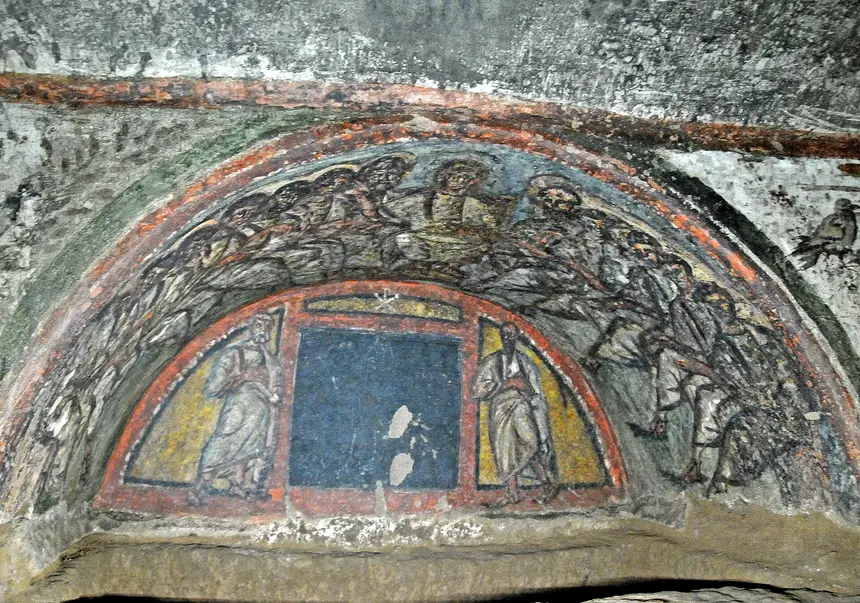
Across the city on Via Salaria, far from the Appia circuit — which is exactly why it stays quiet. Priscilla holds the oldest known image of the Virgin Mary, a 3rd-century fresco of mother and child, and the Greek Chapel, a chamber painted end to end with biblical scenes. If your interest is early Christian art rather than tunnels and tombs, this is the strongest single site in Rome. Groups are small, and you will often share the galleries with no one but your guide. The trade-off is the location: no other catacomb or Appia sight is nearby, so it costs you a dedicated trip north.
The modest option, on Via Nomentana. The galleries around the tomb of the young martyr Agnes are compact and largely fresco-free, so the underground visit is short — but the complex above makes the trip: the basilica of Sant’Agnese fuori le Mura with its 7th-century apse mosaic, and next door the round mausoleum of Santa Costanza, wrapped in some of the finest 4th-century mosaics anywhere. Choose it for a calm, crowd-free morning that combines one small catacomb with two remarkable buildings — not for the tunnels themselves.
One row per catacomb. Every site is guided-only, with the tour included in the ticket.
| Catacomb | Signature sight | Crowds | Booking | Best for |
|---|---|---|---|---|
| San Callisto | Crypt of the Popes, St. Cecilia’s crypt | Busiest — book ahead in high season | Easiest: online in 5 languages, departures ~every 30 min | First-time visitors, history-first travellers, families |
| San Sebastiano | Pagan mausoleums, baroque basilica above | Moderate | Simple on-site; pairs with San Callisto on foot | Appia day-trippers doing two catacombs |
| Domitilla | Underground 4th-century basilica, frescoed hypogea | Moderate | Straightforward; the Wednesday substitute for San Callisto | Atmosphere seekers, Wednesday visitors |
| Priscilla | Oldest image of the Virgin Mary, Greek Chapel | Lightest | Small operation — check times before crossing town | Art lovers, crowd avoiders |
| Sant’Agnese | Tomb of St. Agnes + Santa Costanza’s mosaics next door | Light | Small operation on Via Nomentana | A short, quiet visit off the tourist track |
Skip the agonising — find your row.
The classic pairing is San Callisto + San Sebastiano, because they sit on the same stretch of Via Appia Antica, about 10 minutes apart on foot along the old basalt paving. Take the first San Callisto departure at 09:00, walk south to San Sebastiano for a late-morning tour, then spend the early afternoon on the Appia itself — tombs, cobblestones, countryside.
If you prefer a slower rhythm, split the day around the midday break: San Callisto closes 12:00–14:00 (source: official site catacombesancallisto.it), which is your cue for lunch near the Appia before an afternoon slot elsewhere. Two catacombs is a full, satisfying day; three is a forced march — the tours start to blur together.
Remember the one hard rule everywhere: no self-guided visits exist at any Roman catacomb. You never need to add a tour on top of a ticket — but you do need to land in a departure slot for your language, which is why booking San Callisto ahead is the low-stress move. Options and prices are on the tickets page.
The standard guided tour, or the transfer option that solves the awkward trip out to the Appia.
Entry ticket + official guide — the standard way to visit
Guide in: EN, IT, ES, FR, DE
Hotel-area pickup solves the tricky trip to the Appian Way
Guide in: EN, IT, ES, FR, DE, PL
For most first visits that means San Callisto: pick a date, pick your language, and the official guide does the rest. Most options cancel free up to 24 hours ahead.
Book the San Callisto guided tour · from €15