Catacombs of St. Callixtus: Guided Tour
Entry ticket + official guide — the standard way to visit
Guide in: EN, IT, ES, FR, DE
from €15per personCheck Availability
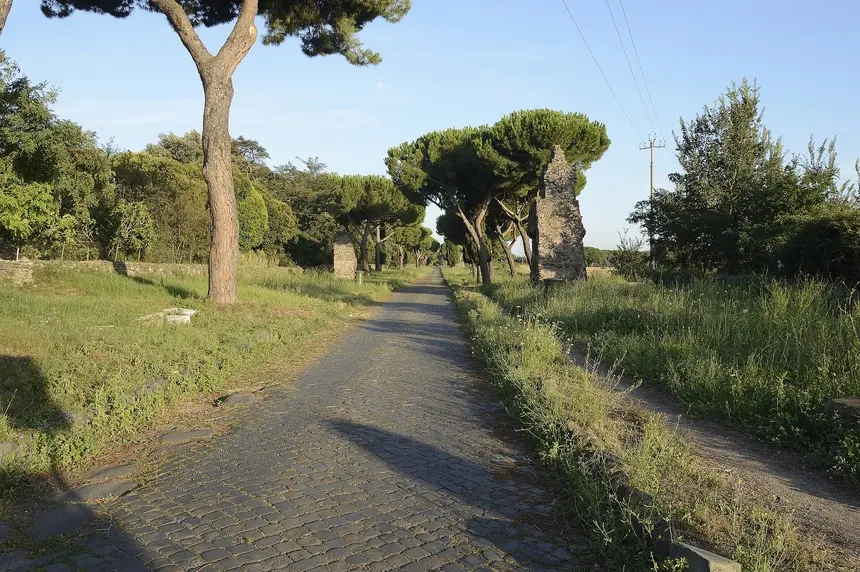
The road Romans called the Queen of Roads is now a regional park where you walk on 2,300-year-old basalt past tombs, towers and two great catacomb complexes. Here is the whole first stretch, ordered as a walkable itinerary — with San Callisto as the anchor of your half or full day.
Live availability · Tiqets
Censor Appius Claudius Caecus began the road in 312 BC to move legions south; in time it reached Brindisi, the port for Greece and the East, 500-plus kilometres away.
Because Roman law banned burials inside the city walls, the Appian Way became Rome's grandest cemetery avenue: patrician mausoleums above ground, and beneath them the tufa galleries of the Appian Way catacombs, where early Christians buried their dead by the hundreds of thousands. Today the first miles are protected as the Parco Regionale dell'Appia Antica — a strip of countryside, pines and ruins that starts ten minutes from the Colosseum by bus.
The Catacombs of San Callisto sit at the heart of that first stretch, and they make the ideal anchor for a day here: a fixed appointment with an official guide, surrounded by sights you can wander freely before and after. This page orders everything as one itinerary heading out of the city, so you can walk it top to bottom — or cherry-pick. For the wider underground picture, see the Rome catacombs guide.
| Appian Way at a glance | |
|---|---|
| Start point | Porta San Sebastiano — bus 118 or 218, or a 20-min walk from Circo Massimo |
| Cost | Road and park free · catacombs and monuments ticketed separately |
| Best day | Sunday or a public holiday — the road is closed to private traffic |
| Avoid | Wednesday if San Callisto is your priority — it closes that day |
| Catacomb hours | 09:00–12:00 & 14:00–17:00 (source: official site catacombesancallisto.it) |
| Surface | Mostly flat; original basalt is uneven — flat shoes, and go slow on a bike |
Source: official site catacombesancallisto.it
Distances below are walkable; everything as far as Cecilia Metella fits a half day on foot. Beyond that, a bike earns its keep.
Sunday rule: on Sundays and public holidays the Appia Antica is closed to private traffic — the single best time to walk or cycle it. Weekday mornings are quiet too, but watch for cars on the narrow first stretch before San Callisto, which has no pavement.
The largest and best-preserved gate in Rome's 3rd-century Aurelian Walls is your starting line. Inside its twin towers, the Museo delle Mura — traditionally free — lets you climb onto the ramparts and walk a stretch of the wall itself, with the Appia stretching south below you. Ten minutes up there resets your mental map: this is where the city ended and the road of tombs began.
A modest 17th-century church at the first fork marks the spot where, legend says, Peter — fleeing Nero's persecution — met Christ walking toward the city. "Lord, where are you going?" Peter asked; the answer, "to Rome, to be crucified again", turned him around to face his own martyrdom. A marble slab in the nave bears the footprints attributed to Christ; it is a copy of the original kept at San Sebastiano, your later stop.
The anchor of the day: the official cemetery of the early Church of Rome, with 20 km of galleries, the Crypt of the Popes and the tomb of St. Cecilia. Entry is only with an official guide — tours run about every 30 minutes in five languages and take 40–50 minutes. Book a slot ahead via the tickets page and build the rest of your walk around it; the pedestrian entrance is signposted off the road, up a cypress-lined avenue.
A short detour along Via Ardeatina leads to a memorial of a different weight. In these tufa quarries, on 24 March 1944, German occupying forces executed 335 prisoners and civilians in reprisal for a partisan attack — one of the gravest atrocities of the occupation of Rome. The site is now a national mausoleum, sober and free to enter. If you visit, allow quiet time; it asks for the same respect as the catacombs themselves.
Back on the Appia, the basilica of San Sebastiano stands over the hollow the Romans called ad catacumbas — "by the hollows" — the place that gave every catacomb in the world its name. Underground, the tour threads through pagan mausoleums swallowed by the Christian cemetery; upstairs the basilica keeps the original Quo Vadis footprint slab. Deciding between the two catacomb tours? The comparison guide settles it.
Just beyond San Sebastiano, the emperor Maxentius built a private circus for chariot races in the early 4th century — and it survives as the best-preserved Roman circus anywhere, better legible than the Circus Maximus in town. The full 500-metre sweep of the track, the starting gates and the spine are all traceable from the ticketed grounds, or largely visible through the fence as you pass.
The drum-shaped tomb of a 1st-century BC noblewoman is the landmark of the whole road — a travertine cylinder later crowned with battlements when the Caetani family turned it into a toll castle in the Middle Ages. It marks the practical turning point for walkers: buses back to town stop nearby, and the handful of trattorie in this cluster are the best lunch bet on the ancient road.
Past Cecilia Metella the modern asphalt gives up, and the Appia becomes what you came for: long runs of original basalt slabs, rutted by cart wheels, lined with pines, tomb fragments and headless statues, running die-straight toward the Alban Hills. Even twenty minutes out and back here is worth it; cyclists should slow down or use the beaten-earth shoulders.
About the fifth mile out, the largest suburban villa of ancient Rome rises from open fields — so splendid that the emperor Commodus had its owners, the Quintili brothers, put to death and took it for himself. Baths, reception halls and aqueduct arches survive at genuinely imperial scale. It is a long walk but an easy ride; the site is ticketed, with an entrance on the ancient road.
East of the Appia, the Park of the Aqueducts is where six ancient aqueduct lines, including the mighty arches of the Aqua Claudia, stride across open meadow — the classic Roman-campagna photograph. It is not on the ancient road itself, but flat lanes make it an easy add-on by bike, and guided e-bike loops pair it with the catacombs area in a single ride.
The park is mostly flat and distances shrink fast by bike — but the basalt sections rattle; an e-bike smooths both the bumps and the one long rise back toward the gate.
Rental points operate near the start of the road and around Cecilia Metella, and the park lanes connecting the Appia to the aqueducts are quiet and signposted. If you would rather not navigate, the guided e-bike tour covers the catacombs area and the Parco degli Acquedotti in one ~4-hour loop, and the minivan sightseeing tour does the road, the countryside and a catacomb visit without any pedalling at all.
Entry ticket + official guide — the standard way to visit
Guide in: EN, IT, ES, FR, DE
Catacombs plus the aqueducts and Roman countryside in one loop
Guide in: EN
Cover the whole Appia Antica park without the walk
Guide in: EN, IT
One constraint shapes every plan: San Callisto closes for lunch from 12:00 to 14:00, and all day on Wednesdays. Slot the guided tour first, then let the road fill the rest.
| Time | Stop |
|---|---|
| 09:00 | Porta San Sebastiano — climb the walls at the Museo delle Mura |
| 09:45 | Domine Quo Vadis, then the walk (or bus 118 one stop) to San Callisto |
| 10:30 | San Callisto guided tour — take a departure well before the 12:00 close |
| 11:45 | Walk on to San Sebastiano; basilica and, if energy allows, its catacombs |
| 12:45 | Circus of Maxentius and Mausoleum of Cecilia Metella |
| 13:30 | Lunch near Cecilia Metella, then bus 118 or 660 back to town |
Manage expectations: the ancient road itself has very few cafés or restaurants. Your realistic options are the bars around the information point near the start of the road, the café at the San Sebastiano end, and a couple of trattorie clustered near Cecilia Metella — book ahead for Sunday lunch, when all of Rome has the same idea. Beyond Cecilia Metella, assume nothing: carry water in summer and snacks if you are riding to the aqueducts.
The sightseeing tour pairs the Regina Viarum and the Roman countryside with a guided catacomb visit — transfer included, no bus timetables to decode.
Book the Appian Way sightseeing tour · from €98