Crypt of the Popes: the “Little Vatican” Inside San Callisto
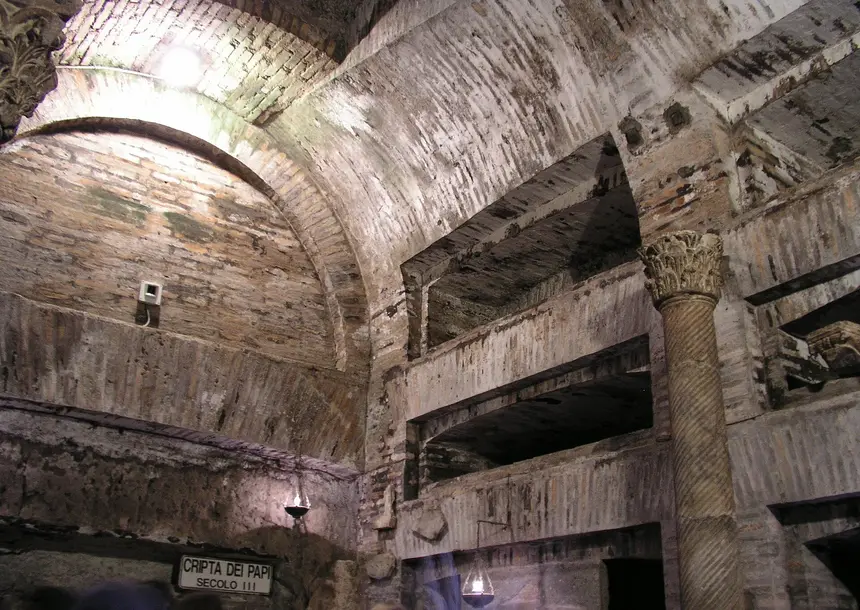
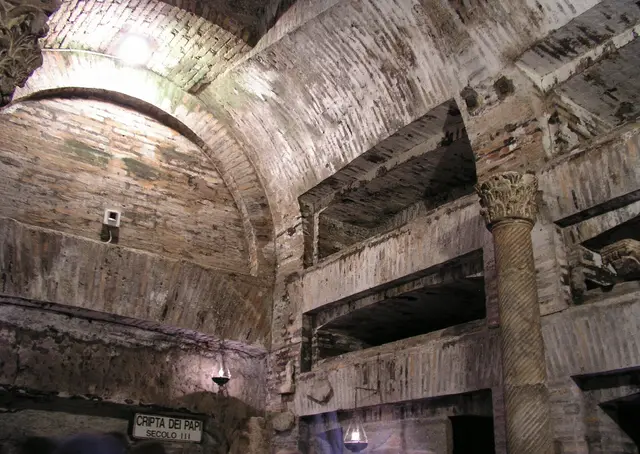
One modest tufa chamber, twenty metres underground, held the tombs of nine 3rd-century popes — men elected during the persecutions, several of them martyred in office. Rediscovered in 1854, it is the emotional centre of every San Callisto tour, with St. Cecilia’s original tomb next door.
- Included in every guided tour — no extra ticket
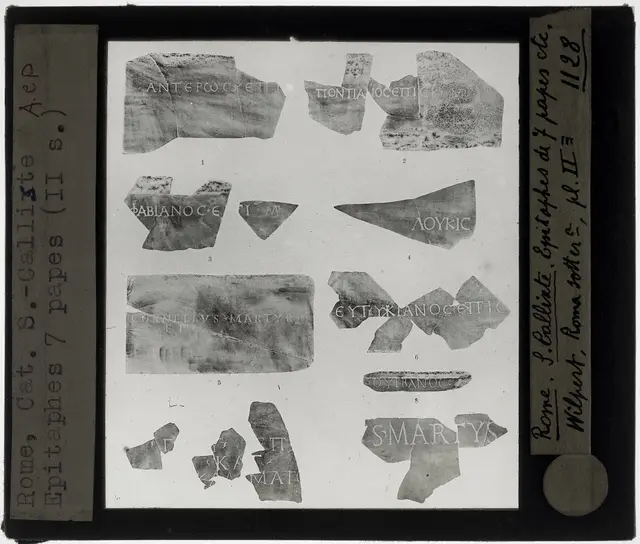
- Five original Greek epitaphs still in place
- St. Cecilia’s crypt is the next stop
- Rediscovered by de Rossi in 1854
Live availability · Tiqets
1854: de Rossi finds the lost papal cemetery
For a thousand years the chamber was forgotten. After the last relics were moved to city churches in the 9th century, the Roman catacombs fell out of use, their entrances collapsed or buried under vineyards along the Appian Way. It took Giovanni Battista de Rossi — the founder of Christian archaeology — to read the clues in medieval pilgrim itineraries and a broken marble fragment bearing part of a papal name.
In 1854 his excavation broke into a square room lined with tomb slabs, and the inscriptions told him exactly where he was standing: the official burial chamber of the bishops of Rome from the age of the persecutions. Pope Pius IX came in person to see it. De Rossi's nickname for the find stuck — the little Vatican: a papal necropolis two centuries older than anything visible at St. Peter's. The full story of the complex is on our history page.
Who lies in the Crypt of the Popes — and why the epitaphs are in Greek
Nine popes of the 3rd century were buried here, in the decades when leading the Church of Rome was close to a death sentence. Five of their original grave slabs survive in place.
The names you can still read, carved in Greek capitals on marble set into the tufa, are Pontian (deported to the Sardinian mines and died there), Anterus, Fabian (executed at the start of the Decian persecution in 250), Lucius I and Eutychian. Most carry a single title after the name: epi(skopos) — bishop. On Fabian's slab a later hand scratched an abbreviation for martyr. No portraits, no grand tombs: flat slabs closing wall niches, like every other burial in the galleries.
Greek, not Latin, because Greek was the language of the early Roman church — the language of its liturgy, its scriptures and much of its congregation, drawn from the Greek-speaking eastern half of the empire. A Latin epitaph for a Roman bishop would have been the odd choice in the 3rd century.
The most dramatic name is honoured rather than labelled. Sixtus II was seized in this cemetery on 6 August 258, during Valerian's persecution, and killed with four of his deacons. A century later Pope Damasus I placed a long marble poem in the crypt celebrating the martyrs buried around it; your guide will point out the inscription, carved in the elegant lettering of Damasus's calligrapher Filocalus. It is the same Damasus who turned the whole complex into a pilgrimage site — the graffiti of early pilgrims still covers the passage walls nearby, many of them scratching the Christian symbols you meet throughout the catacombs.
The Crypt of St. Cecilia, patron saint of music
A short passage links the papal chamber to a second famous room: the crypt where St. Cecilia, Rome's patron saint of music, was originally buried. In 821 Pope Paschal I had her remains moved for safekeeping to the basilica of Santa Cecilia in Trastevere, where they still rest — so what you see here is her empty original tomb, which is precisely what makes it affecting.
In the niche lies a white marble figure of a young woman on her side, face turned away, three fingers extended. It is a copy of Stefano Maderno's sculpture of 1600, said to show Cecilia's body exactly as it was reportedly found when her tomb was opened in Trastevere; the original stands under the altar of the Trastevere basilica. On the crypt walls, early medieval frescoes survive — Cecilia in the jewelled dress of a Byzantine noblewoman, praying figures, a head of Christ.
Guides tell her story well: a Roman noblewoman martyred in the 3rd century, associated with music because tradition says she sang to God in her heart at her wedding. True or embroidered, the sequence of empty tomb, statue and faded fresco is the moment many visitors remember most.
What you actually see, and how long you get
Both crypts are core stops on the standard route — here is how the visit plays out in practice.
| Quick Summary | |
|---|---|
| Extra ticket? | No — the crypt is included in every San Callisto ticket |
| When on the route | Early in the tour, after the descent to the second level |
| Time inside | A few minutes in each crypt, with the guide narrating |
| Lighting | Dim — epitaphs are lit, but give your eyes a moment to adjust |
| Photography | Prohibited underground, as everywhere in the catacombs |
| Languages | Tours in EN/IT/ES/FR/DE, roughly every 30 minutes |
Source: official site catacombesancallisto.it
Group size and guide quality shape the experience — the guided tours page compares the booking options.
Why are 3rd-century popes here and not at St. Peter's?
The short answer: Roman law, and a Church that was still illegal.
Roman law forbade burials inside the city walls — every cemetery, pagan or Christian, lay along the roads outside. And in the 3rd century Christianity was a persecuted minority: there was no basilica of St. Peter (Constantine began it only around 320), no public Christian building of any kind. The community buried its dead, bishops included, in its legally owned cemetery on the Appian Way — the ground a deacon named Callixtus managed before becoming pope himself.
So Rome effectively has two papal necropolises. The Vatican Grottoes under St. Peter's hold popes from the 4th century onwards, in an imperial-scale setting; the Crypt of the Popes holds their persecution-era predecessors in a plain tufa room. Seeing both in one trip is a striking pairing — our guide to the Vatican “catacombs” explains what is really under St. Peter's and how it differs from a true catacomb.
Frequently Asked Questions
Which popes were buried in the Crypt of the Popes?
Can you visit the Crypt of the Popes?
Where is St. Cecilia’s body now?
Is the St. Cecilia statue in the catacombs the original?
Why are the popes’ epitaphs written in Greek?
Is the Crypt of the Popes worth it compared with other catacombs?
See the Crypt of the Popes with a guide
Every San Callisto tour includes the papal crypt and St. Cecilia's tomb — book a slot in your language and the guide brings the stones to life. Most options cancel free up to 24 hours ahead.
Book the guided tour · from €15