What Are Catacombs? Origins, Myths and How They Were Dug
Catacombs are underground burial complexes — networks of galleries and niches cut into soft rock, used mainly between the 2nd and 5th centuries AD. The best known are the Christian catacombs of Rome, dug along the roads outside the ancient walls. Here is what they actually were, where the strange word comes from, and why almost everything Hollywood taught you about them is wrong.
- ~60 catacombs known in Rome
- In use 2nd–5th century AD
- Not secret hideouts — legal cemeteries
- 5 open to visitors today
Live availability · Tiqets
What are catacombs, exactly?
A catacomb is an underground cemetery: a man-made network of narrow galleries, stacked burial niches and small tomb chambers, excavated into rock rather than built. Bodies were laid in individual sealed graves — this was orderly, legal burial, not bone storage and not a hiding place.
The type flourished around the Mediterranean between roughly the 2nd and 5th centuries AD, and Rome is its capital: about sixty separate catacombs ring the city along the consular roads, with hundreds of kilometres of galleries between them. Most were dug by Christian communities, but Jewish congregations and pagan families dug underground tombs too.
When burial in them stopped in the 5th century, the catacombs became pilgrimage shrines, then were gradually abandoned and forgotten — until scholars like Giovanni Battista de Rossi mapped them again in the 19th century. The full arc is on our history page; this page sticks to the basics every visitor should have straight before descending.
“Ad catacumbas”: how one address named them all
The word is a historical accident. On the third mile of the Via Appia there was a natural dip in the terrain, pocked with old pozzolana quarries, that Romans called ad catacumbas — Greek kata kymbas, roughly “by the hollows”. The underground cemetery dug there, beneath what is now the Basilica of San Sebastiano, simply took the name of its location.
That particular cemetery mattered more than most: in the Middle Ages it was one of the few that never dropped out of use or memory, partly because tradition held that the remains of Saints Peter and Paul had once been sheltered there. Pilgrims kept coming, kept saying they were going ad catacumbas — and by extension the address became the generic word for every cemetery of the same underground type, in Rome and far beyond.
So “catacomb” originally named one specific place a ten-minute walk from San Callisto. If you are deciding between the two, our which-catacombs comparison weighs them honestly.
How catacombs were dug: tufa, fossores and lamplight
No caves were harvested and no machines existed. Every metre of gallery was cut by hand — and the geology of Rome is the reason it worked.
The hills south of Rome are made of tufa, a soft volcanic rock with a convenient double personality: easy to carve with picks while underground, hardening on contact with air. It holds a vertical wall without collapsing, so diggers could run narrow, tall galleries and stack tombs from floor to ceiling with no props or masonry.
The diggers were the fossores, a recognised professional corporation within the Christian community — part gravediggers, part surveyors, part mining engineers. Working by the light of oil lamps set in small wall niches, they excavated galleries level by level, dropped ventilation and light shafts called lucernari to the surface, and hauled the spoil up through the same shafts. When a level filled up, they dug stairs down and started another one below — at San Callisto, four levels reaching about 20 m deep.
The vocabulary your guide will use
| Term | What it is | Who it was for |
|---|---|---|
| Loculus | Rectangular shelf niche cut into the gallery wall, sealed with tiles or a marble slab | The standard tomb — the vast majority of burials |
| Arcosolium | Arched recess carved over a flat tomb, often frescoed | Wealthier families and honoured dead |
| Cubiculum | Small room opening off a gallery, holding several tombs | A family or a burial association |
| Forma | Grave cut directly into the gallery floor | Latecomers wanting a spot near a martyr's tomb |
Look up: on a tour, when the guide points out a lucernarium shaft, stand under it. That column of daylight was the fossores' lifeline — ventilation, light and rubble removal in one hole.
Why underground? Law, land prices and one stubborn Hollywood myth
Three practical forces created the catacombs. Persecution, the usual guess, is not one of them.
First, Roman law: burial inside the city walls was forbidden for everyone, which is why all cemeteries — pagan, Jewish, Christian — line the roads leading out of Rome, like the Via Appia Antica. Second, economics: Christian communities buried their dead on donated estates, and those plots were small while suburban land was expensive. Digging down multiplied a narrow field into kilometres of burial space at almost no extra land cost.
Third, belief: Christians insisted on inhumation — burying the intact body, awaiting resurrection — while the older pagan custom favoured cremation and compact urns. Whole bodies need far more room than ash, and shelf niches stacked in tufa galleries were the cheapest way to provide it for a fast-growing community that buried rich and poor alike.
Myth, busted: catacombs were never secret hideouts where Christians lived and dodged Roman soldiers. They were registered cemeteries at known addresses — the authorities knew exactly where they were, and occasionally confiscated them. A damp, dark tunnel full of graves is also a terrible place to live. What is true: during persecutions, Christians did gather at the tombs of martyrs down here to celebrate the Eucharist — worship at the graves, not life in hiding.
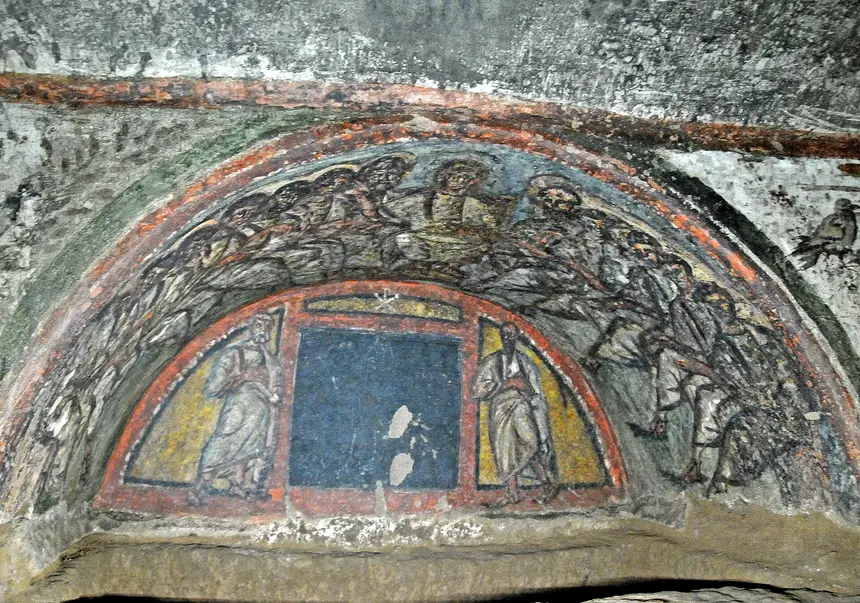
The frescoes prove the point: these are decorated tombs, not fugitive graffiti. Shepherds, fish, anchors, banquet scenes — a coded visual language explained in our guide to early Christian symbols.
Who was buried in the catacombs? Everyone
This is the most radical thing about them. Roman burial normally advertised status — the grander the mausoleum, the greater the family. In the Christian catacombs, a pope's tomb and a labourer's loculus sit in the same tufa, metres apart. At San Callisto, nine 3rd-century popes were laid in the Crypt of the Popes while around half a million ordinary believers filled the galleries around them.
Nor were catacombs an exclusively Christian habit. Rome preserves Jewish catacombs — Vigna Randanini on the Appia and Villa Torlonia on the Via Nomentana, both closed to casual visits or open only by special arrangement — with menorahs and Greek epitaphs in place of fish and anchors. Pagan families dug smaller private tomb complexes, hypogea, some of which got swallowed by expanding Christian networks and survive inside them.
Managing all of this today is the Pontificia Commissione di Archeologia Sacra, the Vatican body responsible for the Christian catacombs — which is why every visit, at every site, comes with an official guide.
Catacombs in Italy and beyond — and the Paris impostor
Rome invented the model, but wherever soft rock met an early Christian community, catacombs followed.
- Naples — Catacombs of San Gennaro: broad, airy galleries on two levels cut into yellow tufa, with some of southern Italy's oldest Christian frescoes and the original tomb of the city's patron saint.
- Syracuse, Sicily — San Giovanni: a vast network reworked from a Greek aqueduct, second only to Rome's in scale, with round rotundas unlike anything on the Appia.
- Malta — Rabat: clusters of small rock-cut cemeteries such as St. Paul's catacombs, famous for their carved “agape tables” where funeral meals were held.
Paris is different: the famous Paris “catacombs” are not ancient and not really catacombs. They are an ossuary created from 1786, when Paris emptied its overflowing parish cemeteries and stacked the bones of millions in disused limestone quarries. Rome: individual tombs, dug on purpose, 2nd–5th century. Paris: relocated bones in an 18th-century quarry. Expect walls of skulls there — and almost none here.
Rome's catacombs now: sixty known, five you can enter
Of the roughly sixty catacombs identified around Rome, most are closed for conservation. Five are regularly open, all guided-only: San Callisto, San Sebastiano, Domitilla, Priscilla and Sant'Agnese.
San Callisto is the flagship: the official cemetery of the early Church of Rome, the largest complex at about 20 km of galleries and around 500,000 burials, and the only one with a papal crypt. If this page made you curious, that is the place to see every concept — loculi, arcosolia, lucernari, frescoes — in the original. Tours run every ~30 minutes in five languages; formats and prices are on the guided tours page.
Frequently Asked Questions
What does the word "catacomb" mean?
Are there still bodies in the catacombs?
How deep are the catacombs?
Are catacombs only Christian?
How many catacombs does Rome have?
Can you visit the catacombs on your own?
What is the difference between a catacomb and a crypt?
Are the Paris catacombs the same thing?
Now see what catacombs are — from the inside
Reading about tufa and loculi takes ten minutes. Standing in a 3rd-century gallery at 16 °C while a guide decodes it is what stays with you. San Callisto is the largest catacomb in Rome and the natural first descent.
Book the San Callisto guided tour · from €15