Christian Symbols in the Catacombs: a Field Guide
Fish, anchor, dove, Chi-Rho — the walls of San Callisto are covered in a code that every 3rd-century visitor could read and most modern ones cannot. Ten minutes with this decoder and the frescoes on your tour turn from faded pictures into sentences.
- The full “12 symbols” set, explained
- Where to spot each one in San Callisto
- No photography inside — memorise before you go
- Written from the actual tour route
Live availability · Tiqets
Why early Christian symbols exist — and what they were for
The Christian symbols in the catacombs were born of a young community working out how to picture a faith that had no visual tradition yet. Greek and Roman religion came with centuries of ready-made imagery; Christianity in the 2nd century had none. So its artists borrowed everyday shapes — a shepherd, a fish, an anchor, a dove — and loaded them with second meanings that fellow believers recognised instantly.
Persecution sharpened the habit. In decades when professing Christ could cost you your life, an anchor carved on a tomb said “hope in the resurrection” to an insider and “sailor's family” to everyone else. One myth needs killing, though: the catacombs were never secret hideouts. They were legal, registered cemeteries dug along the Via Appia Antica — Roman law protected burial sites even when it condemned the religion of the buried. Our what-are-catacombs guide unpacks that history; the history page covers how San Callisto became the official cemetery of the Church of Rome.
What follows is the dictionary. Read it before you descend: the tour lasts 40–50 minutes, the light is low, and photography is banned, so whatever you can already recognise is what you will actually see.
The 12 symbols of the catacombs, decoded
This is the classic set — the twelve images that recur across Rome's catacombs and that your guide will point out (fast) in the galleries of San Callisto.
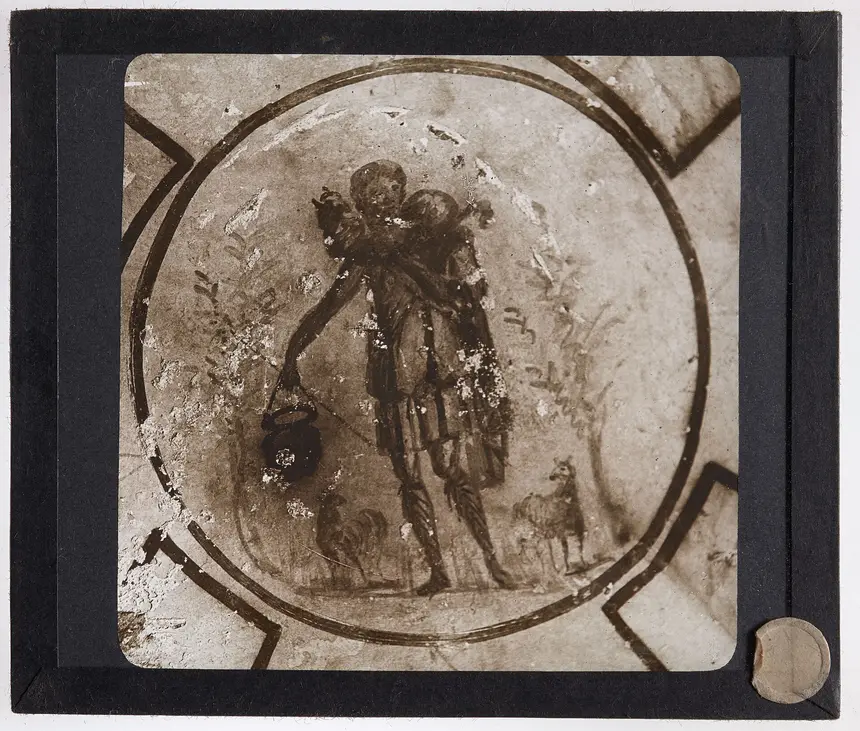
1. The Good Shepherd
A young, beardless man in a short tunic, a sheep across his shoulders, often flanked by two more at his feet. It is Christ as rescuer of the lost soul — “I am the good shepherd” made visible — adapted from a stock figure of Greco-Roman pastoral art, which is why it looked unremarkable to pagan eyes. This is the signature image of San Callisto: the ceiling fresco of the Good Shepherd here is one of the earliest known depictions of Christ anywhere. Expect your guide to stop at it.
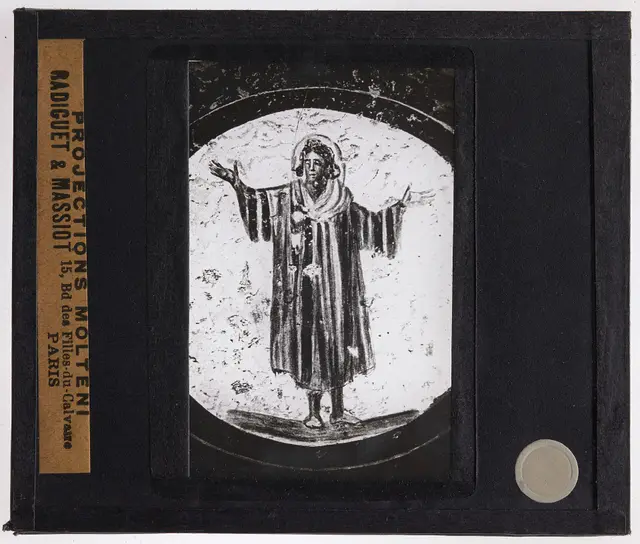
2. The Orante
A standing figure, usually a woman, arms raised and palms open in the ancient gesture of prayer. The Orante represents the soul of the deceased already at peace, praying in paradise — a portrait of where the dead person is now, not of who they were. On tomb slabs and cubiculum walls throughout San Callisto, an Orante beside a name is the painted equivalent of “rest in peace”. Look for the raised arms; the pose is unmistakable even in dim light.
3. The ichthys fish
A simple two-stroke fish, scratched or painted. The Greek word for fish, ΙΧΘΥΣ (ichthys), is an acrostic: Iēsous CHristos THeou Yios Sōtēr — “Jesus Christ, Son of God, Saviour”. A whole creed compressed into five letters and one doodle. It is the most common symbol in the catacombs, appearing on epitaphs and beside loculi across the complex; once your eye is tuned, you will spot fish in nearly every gallery the tour passes through.
4. The Chi-Rho (Christogram)
The letters Χ (chi) and Ρ (rho) — the first two of Christos in Greek — superimposed so the P rises out of the X. It existed earlier, but exploded after Constantine adopted it as his standard around 312 AD, so in the catacombs the Chi-Rho generally flags the later, 4th-century burials made after persecution ended. On San Callisto's epitaphs it often stands between an alpha and an omega, a double declaration in three characters.
5. Alpha and Omega
The first and last letters of the Greek alphabet, Α and Ω, usually hanging either side of a Chi-Rho. They quote the Book of Revelation — “I am the Alpha and the Omega, the beginning and the end” — and claim Christ as lord of all time, including the time of the person in the tomb. On a grave marker the pairing reads as a promise: the end of this life is not the end. Scan the inscription fragments mounted in the crypts for it.
6. The dove with olive branch
A small bird, olive sprig in its beak — Noah's dove returning with proof that the flood was over. On a tomb it means the soul has crossed its own flood and reached peace; epitaphs often add the words in pace. It is among the most frequent carvings on San Callisto's tomb slabs, often paired with the deceased's name. The dove alone, without the branch, carries the same sense of the soul in flight to God.
7. The anchor
An anchor is hope you can hold on to — the Letter to the Hebrews calls hope “an anchor of the soul” — and its crossbar let it double as a discreet cross in centuries when drawing one openly was unwise. It is effectively the cross in working disguise. Anchors are cut into tomb slabs all over San Callisto, sometimes with a fish hanging from the crossbar: hope, anchored in Christ, in two strokes of a chisel.
8. The phoenix
The mythical bird that burns and rises from its own ashes, borrowed straight from pagan legend and re-pointed at the resurrection of the body. Early writers like Clement of Rome were already using the phoenix as proof-by-nature that rising from death was plausible. It is rarer than the fish or dove — you will not see one in every gallery — so treat any long-tailed bird standing on a mound or pyre as a possible phoenix and ask your guide.
9. The peacock
Ancient natural history claimed the peacock's flesh never decayed, which made the bird a ready symbol of immortality and of the incorruptible body awaiting resurrection. The fanned tail, renewed every year, added a hint of eternal spring. Peacocks decorate arcosolia — the arched, wealthier tombs — where there was room for colour. In the painted cubicula of San Callisto, look at the corners and ceiling borders: birds there are doing theology, not decoration.
10. Fish and bread baskets
A fish swimming with a basket of loaves on its back — an image that fuses the multiplication of the loaves and fishes with the Eucharist. Some baskets are painted with a red glass of wine gleaming inside. San Callisto preserves famous versions in the area of the Crypts of Lucina, among the oldest Eucharistic images in existence. It is a dense little picture: Christ (the fish) carrying the bread that the community shared at its altar.
11. The vine
Vines with leaves and grape clusters wind across ceilings and around arches throughout the complex. The reference is “I am the vine, you are the branches” — Christ and his people as one living plant — with a second Eucharistic echo in the grapes that become wine. Because vine scrolls were also standard Roman decoration, this is the stealthiest symbol of the set: identical foliage decorated pagan villas. Context tells you when a vine is just a vine.
12. The IX monogram
Before the Chi-Rho became standard, believers overlapped the Greek initials of Jesus Christ — Ι (iota) for Iēsous and Χ (chi) for Christos — into a six-pointed star shape. Carved small at the end of an epitaph, it was easily taken for a decorative asterisk, which was the point. When you scan the inscription slabs in San Callisto, anything that looks like a starburst next to a name deserves a second look: it may be the oldest monogram of Christ.
The frescoes: Cubicles of the Sacraments and the story scenes
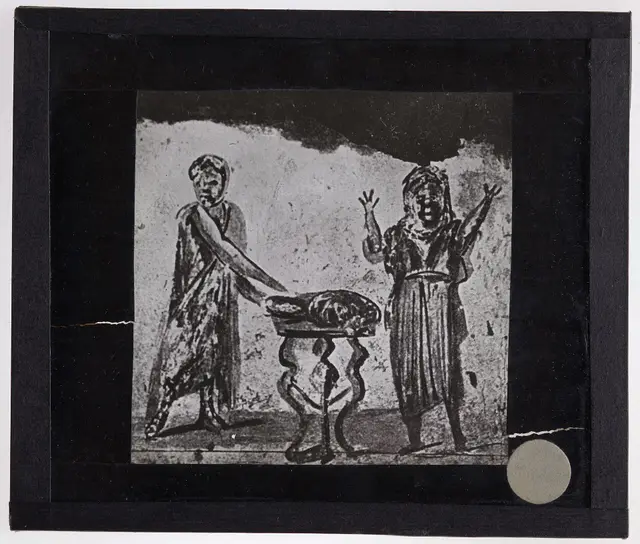
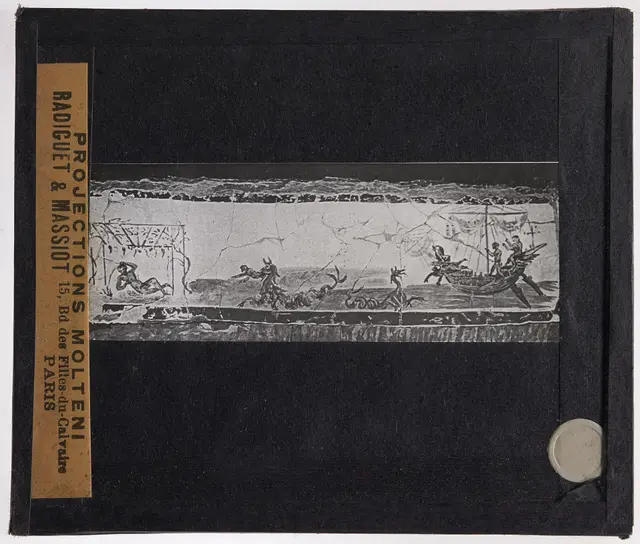
Symbols are single words; the frescoes of San Callisto are full paragraphs. The richest are in the Cubicles of the Sacraments, a run of small 3rd-century family burial chambers directly on the tour route.
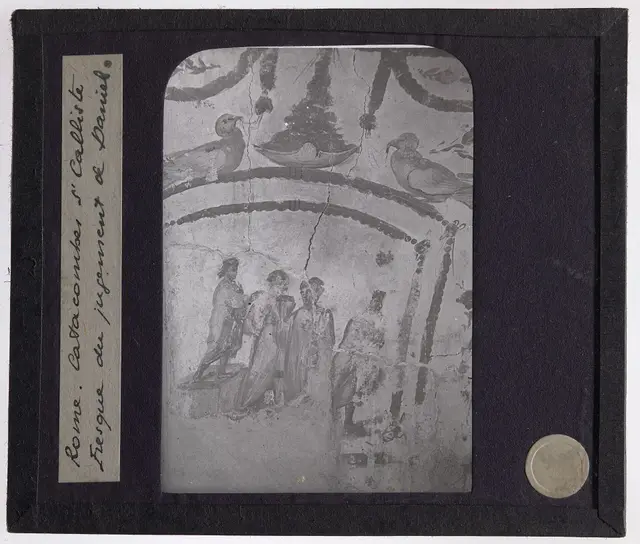
These chambers carry some of the earliest painted cycles of baptism and the Eucharist: a baptiser pouring water, seven figures at a table with fish and bread, a tray of loaves. Around them run Old Testament scenes chosen for one shared message — God rescues. Jonah is the star: swallowed by the sea creature, spat out on the third day, resting under his gourd vine. Early Christians read his three days in the fish as a direct prefiguration of Christ's three days in the tomb, which made Jonah the perfect thing to paint beside your dead. Daniel stands unharmed between his lions; Lazarus steps out of a tomb painted like a little temple. Every scene is the same prayer in different costume: do for this person what you did for them.
How to spot the symbols on your tour
Be realistic about conditions: the guided visit moves briskly through dim galleries for 40–50 minutes, and there is no doubling back. This is why preparation beats improvisation — you cannot photograph anything for later, so what you fix in memory now is what you will recognise underground.
- Galleries between stops: fish, anchors and doves scratched on loculus slabs. Scan at eye level as you walk.
- Crypt of the Popes: Greek epitaphs of the 3rd-century popes — look for doves, wreaths and monograms around the inscriptions.
- Cubicles of the Sacraments: the fresco climax — baptism, the banquet, Jonah, Daniel. Position yourself near the guide here.
- Ceilings: the Good Shepherd and vine scrolls live overhead. Remember to look up; most visitors never do.
Pick three symbols from the dictionary above and hunt only those — a short list beats trying to catch all twelve. Guides on the standard tour answer iconography questions happily if you ask at the stops rather than in the corridors, where groups have to keep moving.
Frequently Asked Questions
What does the fish symbol mean in the catacombs?
What is the Chi-Rho symbol?
Why did early Christians paint a shepherd instead of a cross?
What are the 12 symbols of the catacombs?
Where are the best frescoes in the Catacombs of San Callisto?
Can I photograph the frescoes inside?
See the original Christian symbols in the catacombs
The Good Shepherd ceiling, the Jonah cycle, the fish and the anchors are all on the standard guided route — and a guide who can answer your questions is included in every ticket.
Book the guided tour · from €15