History of the Roman Catacombs: the Story of San Callisto
A cemetery founded around 199 AD, dug to 20 km of galleries, lost for a thousand years, and found again by a scholar following broken marble. This is the history of the Roman catacombs told through their most important site.
- ~199 AD: first cemetery owned by the Church
- 9 popes buried in one crypt
- Rediscovered in 1854
- Story told live by official guides
Live availability · Tiqets
The timeline at a glance
Every date below comes up on the guided tour — knowing them beforehand turns dim corridors into a story you can follow.
Why the history of the Roman catacombs starts on the Appian Way
Rome’s oldest written law, the Twelve Tables, forbade burying or cremating anyone inside the city walls. So the roads out of Rome became avenues of the dead: the Via Appia was lined for miles with mausoleums, funeral altars and family plots, the grandest tombs competing for the best roadside frontage.
Most pagan Romans cremated their dead and stored the ashes in compact urns. Christians could not follow suit: believing in the resurrection of the body, they insisted on inhumation — whole burials, like the Jewish communities of Rome before them. A body needs far more ground than an urn, and roadside land near the city was cruelly expensive.
Through the 2nd century, Christians simply used what everyone else used: private surface tombs and small hypogea on family land along the Appia, pagans and Christians side by side. The community was growing fast, and most of its members were poor. It needed a cemetery of its own — and a way to fit thousands of graves onto a narrow strip of farmland.
~199 AD: a deacon named Callixtus gets the keys
Around 199 AD Pope Zephyrinus placed a deacon called Callixtus in charge of a burial ground on the Appian Way. The moment matters more than it sounds: this was the first cemetery owned and run by the Church itself, not by a wealthy patron. Rich Christian families had lent land before; now the community buried its faithful — including the poorest — under its own administration.
Callixtus managed the digging so effectively that the complex took his name forever. His own story is remarkable: a former slave, once condemned to the Sardinian mines, he rose to become Pope Callixtus I (217–222). The irony is that the man the catacombs are named after is not buried in them. He died in Trastevere — early sources say in a riot — and was laid to rest in the small catacomb of Calepodius on the Via Aurelia, on the other side of Rome.
The 3rd century: persecution, popes and 20 km of tunnels
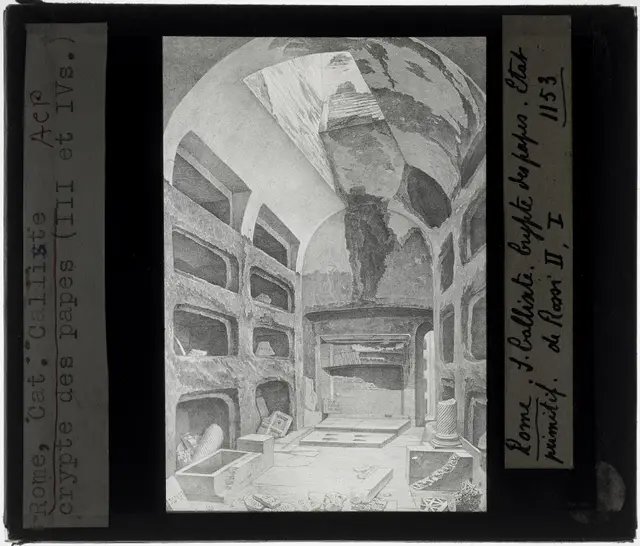
The 3rd century was the catacomb’s boom era — and its darkest. Empire-wide persecutions under Decius (250) and Valerian (257–258) targeted the Church’s leaders directly. On 6 August 258, Pope Sixtus II was seized while presiding at a liturgy in the catacombs and executed with four of his deacons. He was buried a few steps away, in the chamber now called the Crypt of the Popes, where nine 3rd-century popes eventually lay beneath Greek epitaphs you can still read today.
The digging itself was the work of the fossores — professional excavators who cut the galleries by the light of oil lamps, following the seams of soft volcanic tufa. Skilled and organised, they later formed a recognised corporation within the Church and by the 4th century were even selling burial spots. Their picks opened roughly 20 km of galleries on four levels, with tens of thousands of shelf-graves — loculi — stacked floor to ceiling.
Here the biggest myth needs burying too. The catacombs were never secret hideouts: they were legal, registered cemeteries, protected by Roman funerary law, with entrances visible from the road. Christians did gather at martyrs’ tombs down here for funerals and anniversary rites, and in the worst years those gatherings were discreet by necessity — but nobody lived in the tunnels, and the authorities always knew exactly where they were. Sixtus II’s arrest proves it.
The 4th century: from cemetery to shrine
Constantine’s toleration of Christianity in 313 changed everything. With persecution over, the catacombs stopped growing as cemeteries and started growing as destinations. Pilgrims came from across the empire to pray at the tombs of the martyrs, scratching their names and petitions into the plaster beside frescoes of the Good Shepherd and the symbols of the early Church.
Pope Damasus I (366–384) turned veneration into architecture. He hunted down neglected martyr tombs, widened staircases and light shafts for the crowds, and dressed the graves in monumental marble inscriptions composed in his own verse — the elegant Damasian lettering that guides still point out in the Crypt of the Popes.
Decline: sieges, relic translations and a thousand years of silence
The catacombs died with the suburbs around them. Gothic armies besieging Rome in the 6th century and Lombard raiders in the 8th looted the countryside along the consular roads, and the martyr shrines outside the walls became indefensible. The popes drew the obvious conclusion: bring the saints inside.
Through the 9th century, cartloads of relics were translated from the catacombs to churches within the walls. St. Cecilia, the most famous burial at San Callisto after the popes, was moved to her basilica in Trastevere in 821. With the relics gone, pilgrimage stopped; with pilgrimage gone, maintenance stopped. Entrances collapsed or were buried under vineyards, and within a few generations Rome forgot where — and largely that — the catacombs existed.
Rediscovery: Bosio’s lamp and de Rossi’s broken marble
In 1593 a young Maltese scholar named Antonio Bosio lowered himself into a hole in a vineyard and began four decades of systematic underground exploration — earning him the nickname “Columbus of subterranean Rome”. His posthumously published Roma Sotterranea proved the catacombs were real, vast and Christian, though many of his identifications remained guesses.
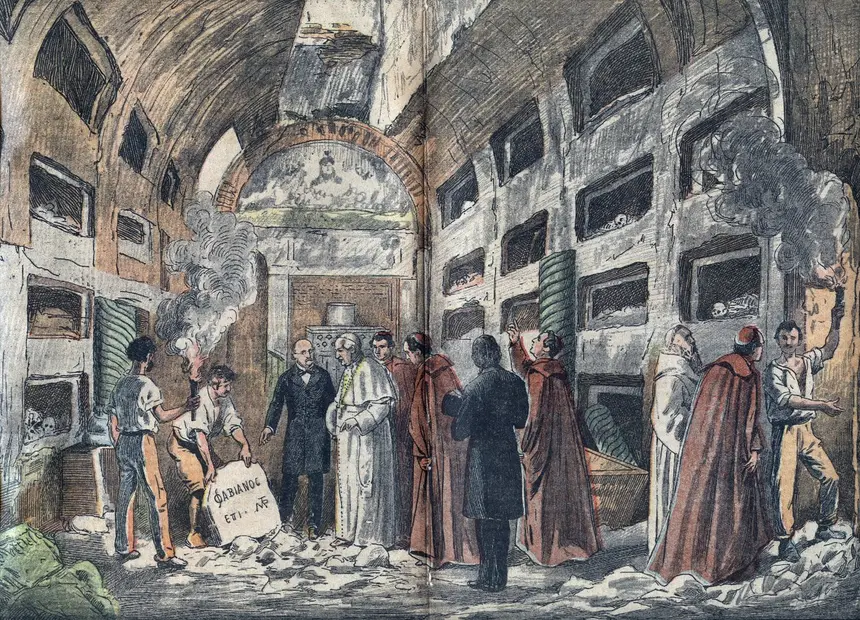
The science arrived with Giovanni Battista de Rossi, founder of Christian archaeology. In 1849 he spotted a broken marble slab in a vineyard on the Appia reading …NELIUS MARTYR — the tomb inscription, he argued, of Pope Cornelius. He convinced Pope Pius IX to buy the vineyard, excavated, and in 1854 identified the Crypt of the Popes from the fragments of papal epitaphs he pieced back together. Pius IX came down in person to see it — the scene in the painting at the top of this page — and, tradition records, was moved to tears by the names of his predecessors.
The catacombs of San Callisto today
Since 1852 the Roman catacombs have been overseen by the Pontificia Commissione di Archeologia Sacra, the Vatican body responsible for their excavation and conservation; day-to-day custody of San Callisto is entrusted to the Salesians of Don Bosco, who run the site and its guides. Conservation never stops — humidity, algae and simple foot traffic all threaten the frescoes, which is one reason photography is banned and entry is possible only with an official guide.
That guide is the last chapter of the history of the Roman catacombs: the same site that Callixtus administered, Damasus embellished and de Rossi dug back into the light is now walked every day, in five languages, thirty minutes at a time. Read our primer on what catacombs actually are before you go — then go and stand in the crypt that made Pius IX weep.
Frequently Asked Questions
Who built the catacombs of San Callisto?
Were the catacombs secret hiding places for persecuted Christians?
Why did the early Christians bury their dead underground?
Who was Callixtus, and is he buried here?
Who rediscovered the catacombs of San Callisto?
Are there still bones in the catacombs?
Hear the full story where it happened
Every ticket includes an official guide who walks you through eighteen centuries in under an hour — from the fossores’ pick marks to de Rossi’s reassembled epitaphs.
Book the guided tour · from €15